Terrace before a sale
A buyer's surveyor could not see the rafters, so the sale paused. Soft foam came away readily, the timbers were sound, and the photographs and readings went to the buyer's surveyor.
- Loft:
- Up to 50 m²
- Foam:
- Open cell

Call us on01727 326304
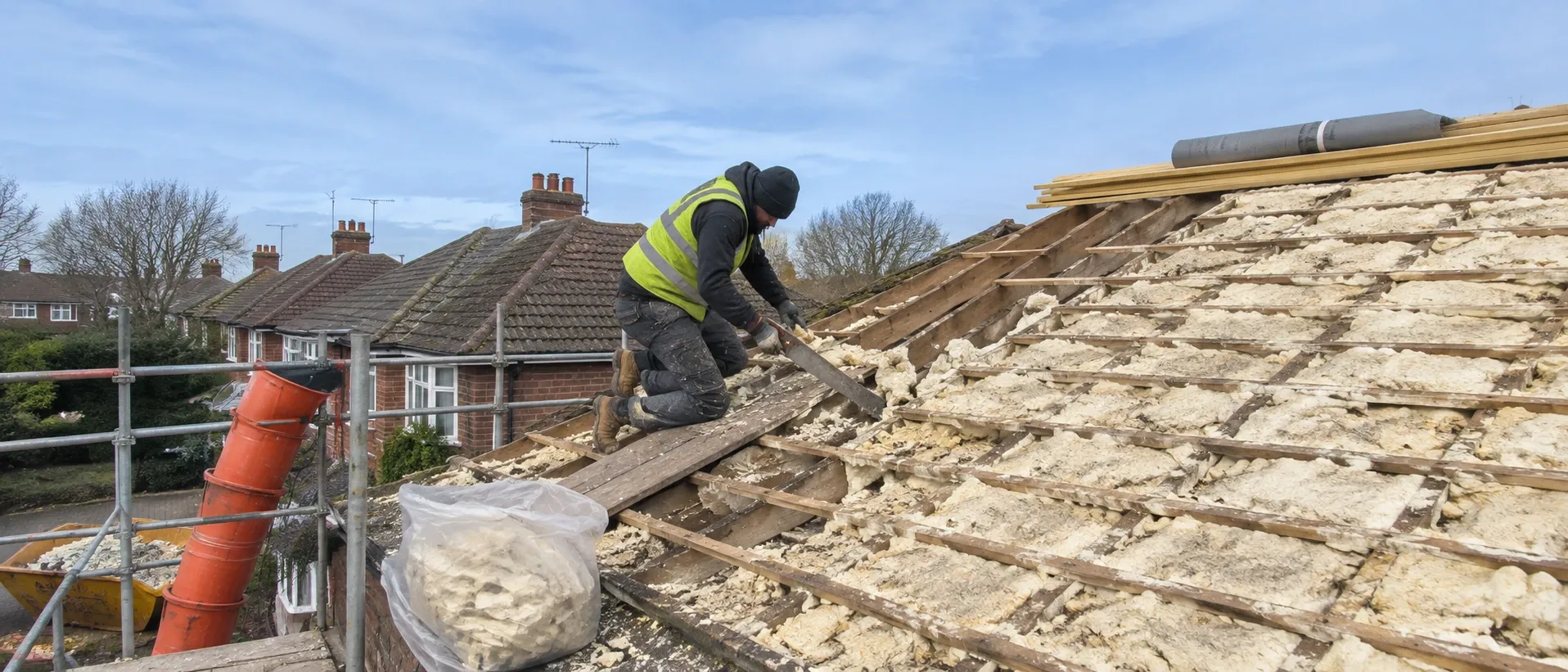
Has a surveyor or lender flagged spray foam in your loft? The foam hides the roof timbers, so a valuer cannot judge the roof, and a sale or remortgage can stall. Our spray foam removal takes it off, cleans and checks the timbers, records their condition and insulates the roof again across England, Scotland and Wales.
Send us what your surveyor or lender has asked for, and we will quote for the removal, the timber checks and the new insulation.
Get a free quoteSpray foam removal is taking sprayed insulation off the underside of a roof, cleaning the timbers beneath it and insulating the loft again with materials that can be inspected.
Spray foam insulation removal, sometimes called loft foam removal, takes off a layer that covers the rafters, battens and roof covering completely. Once it is off, the roof can be seen, repaired where it needs it and insulated again.
Spray foam goes onto the underside of the roof, between the rafters or over them, and sometimes straight onto the felt or the tile battens. It was often fitted as an energy upgrade, and it hides both the timbers and the roof covering from view.
Spray foam insulation is a polyurethane foam, sprayed as a liquid that expands and sets where it lands. It was sold widely as an energy upgrade, sometimes through grant schemes, and comes as soft open-cell or rigid closed-cell foam.
The record we leave covers what was removed and how the timbers looked, so you have it to hand if a buyer or lender asks.
Spray foam is not always a problem in itself, but it can hide one, and spray foam removal is often the only way to see the timbers clearly.
Trouble is most likely where closed-cell foam was sprayed onto felt that does not breathe, or where a leak has soaked into open-cell foam. Condensation then sits against the wood, out of sight.
| Finding | What it can mean |
|---|---|
| Foam covering the rafters | Timbers cannot be inspected |
| Closed-cell foam on the felt | Moisture held against the wood |
| Damp or stained timber | Condensation or a leak |
| Soft or crumbling rafters | Rot that needs repair |
| Rusted nails and fixings | Moisture over a long time |
We record what we find under the foam with photographs and moisture readings, and price any repair separately once we have seen the timbers.
When a buyer's survey or a lender's valuation flags spray foam, spray foam removal is often what stands between you and the sale. A sale usually has a date to keep.
The sooner we see the loft, the sooner you have a quote and a date to give your buyer or lender. Any timber repairs come to light early too, while there is still time to plan them.
If your completion or offer date is tight, give us the date when you get in touch, so the survey and the work can be planned around it.
Some lenders will offer a mortgage on a house with spray foam insulation, but many ask for spray foam removal or a specialist report first. Their valuer cannot see the roof timbers.
Lenders have raised spray foam since at least 2021, and one investigation found five of the 20 largest lenders declining it outright. Equity release providers are stricter still, and the same question comes up again whenever a buyer's lender values the house.
| Lender's stance | What it tends to ask for |
|---|---|
| Declines spray foam | Removal before it will lend |
| Decides case by case | A report or removal |
| Accepts with evidence | A specialist inspection report |
| Equity release provider | Removal in most cases |
A valuer judges a roof by its timbers, and spray foam hides them, so many lenders treat it as a risk they cannot price. Some decline outright, some decide case by case, and some lend once a report shows the roof is sound. Our guide to spray foam and mortgages sets out what each tends to ask for.
A specialist inspection report records the foam, where it sits and the state of any timber that can be seen, often with moisture readings. Some lenders accept one in place of removal, but a report cannot show timbers the foam still hides. See inspection report or removal.
Ask your lender or broker which of these applies to you before booking anything. Their answer decides whether a report or full removal is the right step.
Spray foam removal covers open-cell and closed-cell foam, and the kind in your roof sets the method, the labour and the price. Foam is sprayed between the rafters, over them, or straight onto the roof covering, and each way of fitting it comes off differently.
Open-cell foam is soft, light and comes away more readily, while closed-cell foam is rigid and bonds hard to timber and felt. That makes closed-cell slower and heavier work. We identify the type at the survey, and it sets the method, the time and the price.
Press it with a finger: open-cell foam is soft, dents and crumbles at the edges, while closed-cell foam is hard and rigid and barely gives. Colour is no guide, since both come in white, cream or yellow. More on open-cell and closed-cell foam.
Where the felt or tiles are badly damaged, or the foam is bonded too hard to come off from inside, stripping the roof from outside can make more sense. It costs more, but a breathable membrane goes on at the same time. We say at the survey which route suits.
Foam can be removed from one area only, such as round a leak or for an inspection. Surveyors and lenders usually look at the whole roof, though, and foam left behind may be raised again later. We settle the extent with you at the survey.
You may not know which kind is in your roof. We find out at the survey, and the answer goes into your quote.
Spray foam removal typically costs £2,500 to £6,000 for a whole loft, with the size of the roof and the type of foam setting where in that range it falls. That range covers the removal, protection, waste disposal, timber check and new insulation. Each loft size below is priced on the same basis.
| Loft | Roof area | Price range |
|---|---|---|
| Small loft | Up to 50 m² | £1,500 to £3,000 |
| Medium loft | 50 to 90 m² | £2,500 to £5,000 |
| Large loft | Over 90 m² | £4,000 to £8,000 |
Typical ranges for a whole loft; your quote from us sets out the exact cost after a survey.
The size of the roof comes first, then the type of foam, its thickness and how hard it is bonded. Loft access, the volume of waste and any timber repairs also move the figure, and closed-cell typically costs 50% to 70% more than open-cell. The survey sets your figure.
Removal alone is often priced by the area of the roof, at around £20 to £50 per m², with open-cell foam at the lower end and closed-cell at the upper. The new insulation is added on top, and our spray foam removal cost guide explains what else moves the rate.
Your quote from us lists the removal, the protection, the disposal of the waste, the timber check and report, and the new insulation. Timber repairs are priced separately once the timbers have been seen, because nobody can judge them while the foam covers them.
The survey shows us the foam type, its thickness and the state of the timbers, so the figure in your quote is for your roof and not a typical one.
Most people have spray foam removal done because a surveyor, lender or buyer has raised the foam, and others because they want the roof timbers seen.
Spray foam can trap moisture against rafters and battens, especially closed-cell foam over non-breathable felt. Condensation, rot and rusting nails can then go unseen. Not every roof is affected, but taking the foam off lets the timbers be seen and dried.
No law says spray foam must come out, and a survey report can be enough for some owners and some lenders. Removal settles the question for good and lets the timbers be seen. The choice is yours once you know what your lender or buyer needs.
If you are unsure whether removal is the right step, say so when you contact us and we will explain what a survey of your loft would involve.
In England, often: spray foam removal ends with new roof insulation, and the thermal standards apply to it, so significant changes to a roof's thermal performance normally need approval. In England the thermal standards apply to the new insulation. Scotland and Wales have building rules of their own, and the work is specified to them.
| Work | What applies |
|---|---|
| Insulating the roof again | Thermal standards of the regulations |
| Major roof renovation | Building regulations approval |
| Replacing roof timbers | May need building control |
| Listed building | Listed building consent |
England's position for a typical house. Your survey confirms which of these apply at your address.
In England, insulating the roof again brings in the thermal standards of Part L, and significant changes normally need approval. Scotland and Wales have building rules of their own, which we work to there.
The foam is bagged in the loft, carried out and taken away under the waste duty of care to a licensed site. We carry waste under the carrier rules that apply. It is disposed of as waste, so we make no recycling claims.
Work that affects the character of a listed building can need listed building consent, and that includes the choice of new insulation. Older roofs also need breathable materials. We check both at the survey, before any work starts on the roof.
You can ask for a quote before any of this is settled. We check what applies to your roof and tell you early if building control or consent is involved.
Spray foam removal runs in five stages, from a survey of the loft to new insulation laid over clean timbers. The foam type we find at the survey sets the method, so most of the planning happens in the first stage.
Spray foam removal typically takes 1 to 3 days on site, including the new insulation, and that is a typical range, not a promise. The area of roof, closed-cell foam, loft access, timber repairs and the weather for any roof work all move it.
Once the foam is off, we clean the timbers of residue, check them and take moisture readings and photographs. You receive a written record of the removal and the condition we found, for you, a surveyor or a lender. It is a record, not a guarantee that anyone will accept it.
We cut and scrape the foam off by hand, using bladed scrapers and oscillating tools to free it from the rafters, battens and felt. Blasting is faster on bare timber but can tear the felt and spread debris through the house, so we keep to hand work in a lived-in home.
Dust sheets and floor protection run from the loft hatch to the front door. The work is done from inside the loft, and the foam is bagged where it is cut. We clean down afterwards, and the household usually stays in the house, although we make no promise of zero mess.
Your quote from us sets out the stages for your roof, including any timber repairs once we have seen the timbers beneath the foam.
After spray foam removal your loft is insulated again with materials that can be inspected, and the timbers have a record of their condition on file. The loft is either a cold one, insulated at the joists, or a warm roof, insulated between the rafters. Which suits depends on your roof and on how you use the space.
Usual choices are mineral wool between the joists for a cold loft, or wood-fibre or rigid PIR boards between the rafters for a warm roof. A breathable membrane goes in where needed. We choose to suit your roof and how the loft is used, and surveyors recognise these materials.
A cold loft needs an air path from the eaves to the ridge, while a warm roof relies on breathable layers. Condensation is worth watching in the first winter. We set out the ventilation in your quote, so it is part of the job and not an afterthought.
Once the new insulation is laid, the loft can be used for storage. Boarding over the joists needs raised supports, so the insulation is not squashed. If you plan a conversion, tell us at the survey, because it changes which insulation suits.
Tell us at the survey if you plan to board or convert the loft, because that changes which insulation suits.
Most spray foam removal jobs we take on follow a buyer's survey, a lender's valuation or an application for equity release. Every loft differs in size, foam and timber condition, so these examples show the usual shape of a job rather than a particular customer's.
A buyer's surveyor could not see the rafters, so the sale paused. Soft foam came away readily, the timbers were sound, and the photographs and readings went to the buyer's surveyor.
The lender's valuer flagged closed-cell foam bonded to the felt. Removal took longer, a pair of rafters needed repair, and the loft was insulated again at the joists.
An equity release provider would not proceed with foam in the roof. After removal and new insulation between the rafters, our timber report went with the application.
Foam sprayed straight onto the tiles had bonded too hard to come off from inside. We stripped the roof from outside, and new battens, a breathable membrane and the sound tiles went back on.
Your job will have its own mix of foam, timbers and deadlines, and the survey of your loft is where we work that out.
Our spray foam removal work covers towns and villages across England, Scotland and Wales, from terraced houses in city streets to detached homes in the countryside.
Where you live shapes the roof more than the foam, and slate is common in Wales and the north, and clay or concrete tiles across much of England. Many Scottish roofs have timber boards under the slates that foam can bond to. We plan each removal around the roof we find at the survey.
If your town is not listed, send us your postcode with your enquiry and we will confirm whether we cover your area.
Usually yes, because the work is in the loft and reached through the hatch. There is noise and some dust near the hatch, so we ask that children and pets keep clear of the landing while the foam is coming out.
Foam bonded to felt or tiles can pull at them, which is why we remove it carefully by hand. Damage found under the foam is recorded and priced, not hidden. We cannot promise the roof will be undamaged, but we work to keep it intact.
Spray foam removal is possible without a contractor, but it is slow, dusty and risky for the felt and tiles, and waste rules apply to the foam. A surveyor or lender may also want a record of the work, which is easier when a specialist has done and documented it.
Equity release providers tend to be stricter than mortgage lenders, and most want spray foam out before they will lend. A remortgage brings a fresh valuation, so the same question comes back. We remove the foam and leave the timber photographs and moisture readings for the valuer.
Some owners were sold spray foam through cold calls or grant schemes and later struggled to sell or mortgage the house. Complaints have been taken up with sellers and through official routes, though we cannot advise on a complaint, but our before-and-after photographs can support one. More in mis-sold spray foam.
A standard loft hatch is usually fine, because the foam is cut and bagged in small pieces. A tight hatch or no hatch at all is noted at the survey. A loft ladder helps with carrying the bags down and the new insulation up.
Age matters less than the type of foam and how firmly it is bonded. Closed-cell foam, and foam sprayed straight onto felt or tiles, is the slowest to take off. Old leaks can have soaked open-cell foam, which makes the waste heavier.
A quote for spray foam removal starts with what you know about the foam and why it is coming out. Fill in the form or call with the basics, and we will arrange to see the loft.
It helps to know the kind of foam if you do, roughly how big the house is and whether a surveyor or lender has written about it. A photo of the underside of the roof from the hatch is useful too.